SMS Marketing
March 26, 2026
TheSMSBox Team
WhatsApp API for E-commerce: Guide to Customer Acquisition and Retention
In today’s hyper-competitive e-commerce landscape, capturing customer attention is only half the battle; keeping it is the real challenge. As email open rates hover around 20% and social media algorithms become increasingly unpredictable, brands are turning to a more direct, intimate, and highly engaging channel: WhatsApp.
With over 2 billion active users globally, WhatsApp is no longer just a messaging app for friends and family. It has evolved into a powerhouse for conversational commerce. However, for growing e-commerce brands, the standard WhatsApp Business app falls short. Enter the WhatsApp Business API—a scalable, programmable solution that integrates directly with your tech stack to automate marketing, sales, and support at scale.
This guide explores how e-commerce brands can leverage the WhatsApp Business API to drive explosive customer acquisition and build unbreakable customer retention.
Part 1: Understanding the WhatsApp Business API
Before diving into strategies, it is crucial to understand what sets the WhatsApp API apart from the standard WhatsApp Business app.
The standard app is built for micro-businesses. It operates on a single device (or linked devices) and requires manual typing or basic quick replies. The WhatsApp Business API, on the other hand, has no front-end interface. It is designed to be integrated with third-party platforms (like CRMs, Shopify, WooCommerce, or customer support software) to unlock enterprise-level capabilities:
Unlimited Multi-Agent Access: Entire teams can manage customer queries from a single WhatsApp number.
Deep Integrations: Connect seamlessly with inventory systems, CRMs, and payment gateways.
Advanced Automation: Deploy AI-powered chatbots to handle FAQs, product recommendations, and order tracking 24/7.
Mass Broadcasting: Send personalized promotional messages, back-in-stock alerts, and newsletters to thousands of opted-in customers simultaneously without the risk of being blocked.
By unlocking these features, the WhatsApp API transforms a simple chat window into a full-funnel sales and support engine.
Part 2: Customer Acquisition Strategies Using WhatsApp API
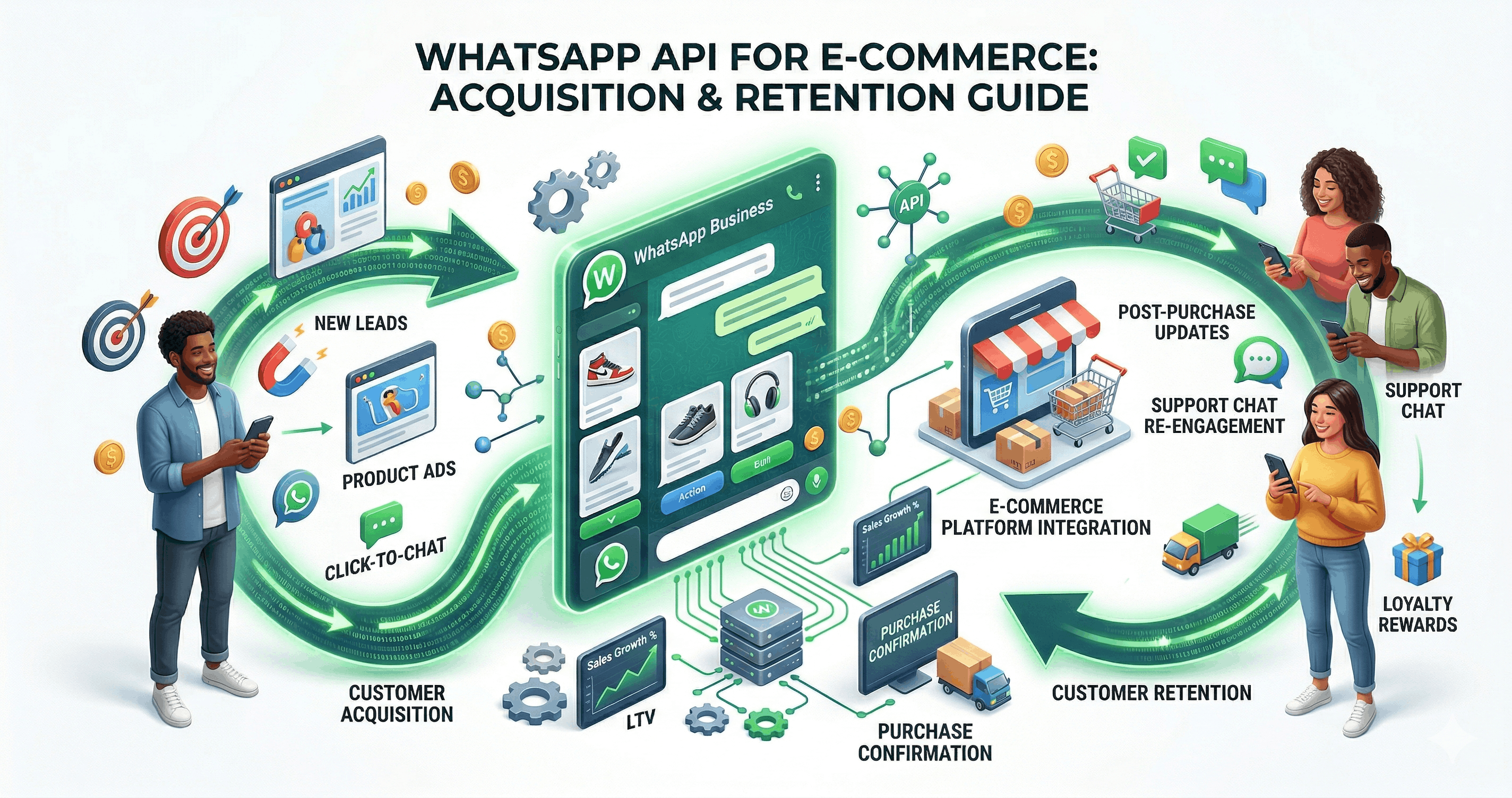
Customer acquisition in e-commerce is becoming increasingly expensive due to rising ad costs. WhatsApp API helps optimize your Return on Ad Spend (ROAS) by creating frictionless entry points and engaging leads instantly.
1. Click-to-WhatsApp Ads (CTWA)
Traditional Facebook and Instagram ads redirect users to a website landing page, where a significant percentage bounce before adding a product to their cart. Click-to-WhatsApp ads change this dynamic. When a user clicks your ad, they are immediately redirected to a WhatsApp chat with your brand, complete with a pre-filled message.
Why it works: You instantly capture the lead's phone number and profile name. Even if they don’t buy immediately, you now have a direct line to re-target them organically, bypassing future ad costs.
The API Advantage: The API can instantly trigger an automated chatbot flow the second the user hits "send," greeting them by name, showcasing the product they clicked on, and offering a quick-buy button.
2. Lead Generation via Website Widgets and QR Codes
Turn your passive website traffic into active conversations. By placing a WhatsApp chat widget on your website, you provide a low-friction way for hesitant shoppers to ask questions.
Website Pop-ups: Instead of asking for an email address in exchange for a 10% discount, ask visitors to subscribe via WhatsApp. The opt-in rate is often higher, and the engagement rate is exponentially better.
Offline to Online: For omnichannel brands, printing QR codes on packaging or in-store displays allows offline shoppers to instantly connect with your digital storefront, bridging the gap between physical and online acquisition.
3. Automated Welcome Flows and Interactive Catalogs
First impressions matter. When a new prospect messages your brand, the API can trigger a rich welcome sequence.
Instead of a plain text greeting, send an Interactive Message featuring native buttons (e.g., "Shop Men," "Shop Women," "Talk to Support").
You can integrate your e-commerce product catalog directly into WhatsApp. Customers can browse categories, view product images, read descriptions, and even add items to their cart without ever leaving the WhatsApp interface. This frictionless experience drastically reduces drop-offs and accelerates the first purchase.
Part 3: Customer Retention & Maximizing Lifetime Value (LTV)
Acquiring a customer is expensive; retaining them is profitable. WhatsApp’s staggering 98% open rate makes it the ultimate channel for retention marketing.
1. Abandoned Cart Recovery
Cart abandonment is the bane of e-commerce, with an average of 70% of shoppers leaving items behind. Email reminders often end up in the spam folder, but a WhatsApp message pings directly in the user’s pocket.
The Strategy: Use the API to set up an automated trigger. If a user abandons a cart, send a friendly WhatsApp reminder 30 minutes later.
The Follow-up: If they still don't purchase, send a second automated message 24 hours later with a limited-time discount code and a quick-reply button linking directly to their pre-filled checkout page. E-commerce brands using WhatsApp for cart recovery routinely see conversion rates 2x to 3x higher than email.
2. Proactive Post-Purchase Communication
Buyer's remorse and shipping anxiety are real. You can eliminate post-purchase dissonance by keeping the customer informed at every step.
Transactional Alerts: Automatically send order confirmations, packing updates, and real-time shipping tracking links via WhatsApp.
Why it matters: Customers no longer have to hunt through their emails or log into your website to check their order status. This proactive approach significantly reduces "Where is my order?" (WISMO) support tickets, saving your team countless hours while delighting the buyer.
3. Personalized Cross-Selling and Upselling
Because the API integrates with your CRM and purchase history data, you can send highly targeted, personalized recommendations.
If a customer buys a coffee machine, set an automated API rule to send them a WhatsApp message a month later offering a discount on coffee pods or descaling liquid.
Instead of generic mass blasts, these tailored messages feel like personalized concierge service, driving high-converting repeat purchases.
4. Frictionless Customer Support (AI + Human Handover)
Excellent support is the backbone of customer retention. The WhatsApp API allows you to build sophisticated AI chatbots capable of handling 70-80% of routine queries—such as return policies, size guides, and refund statuses—instantly, 24/7.
Seamless Handover: For complex issues, the bot can seamlessly route the conversation to a live human agent. The agent receives the full chat history, ensuring the customer doesn’t have to repeat themselves. This speedy, empathetic support builds deep brand loyalty.
5. VIP Loyalty Programs and Replenishment Alerts
Reward your best customers by treating WhatsApp as an exclusive VIP channel.
Send early access links to new product drops or exclusive sales only to your WhatsApp subscribers.
For consumable products (like skincare, supplements, or pet food), set up automated replenishment reminders. E.g., "Hi Sarah, it looks like you might be running low on your Vitamin C serum! Tap below to reorder in one click."
Part 4: Best Practices and Compliance
While the WhatsApp API is incredibly powerful, it comes with strict rules designed to protect users from spam. Adhering to these best practices is essential for success.
Always Secure Opt-ins: You cannot message a customer proactively unless they have explicitly opted in to receive WhatsApp notifications from you. Ensure your opt-in checkboxes at checkout or on landing pages are clear and compliant.
Understand the 24-Hour Rule: When a customer messages you, a 24-hour "customer service window" opens. During this time, you can message them freely. Once the 24 hours pass, you can only initiate conversations using pre-approved "Message Templates" (which cost a small fee per message).
Focus on Value, Not Spam: Just because you can send a message doesn't mean you should. Keep your promotional broadcasts highly relevant, segmented, and spaced out. If users block or report your number, Meta can downgrade your quality rating or suspend your API access.
Use Rich Media: Text-only messages are boring. Leverage the API’s ability to send high-quality images, PDFs, videos, and interactive buttons to make your brand stand out.
Conclusion
The WhatsApp Business API is completely reshaping how e-commerce operates. It collapses the traditional marketing funnel, bringing acquisition, conversion, support, and retention into a single, seamless chat thread.
By shifting from passive email marketing to active conversational commerce, e-commerce brands can significantly lower their customer acquisition costs, skyrocket their conversion rates, and build long-lasting relationships that drive sustainable revenue growth. The businesses that adopt and master this technology today will undoubtedly be the market leaders of tomorrow.