SMS Marketing
April 2, 2026
TheSMSBox Team
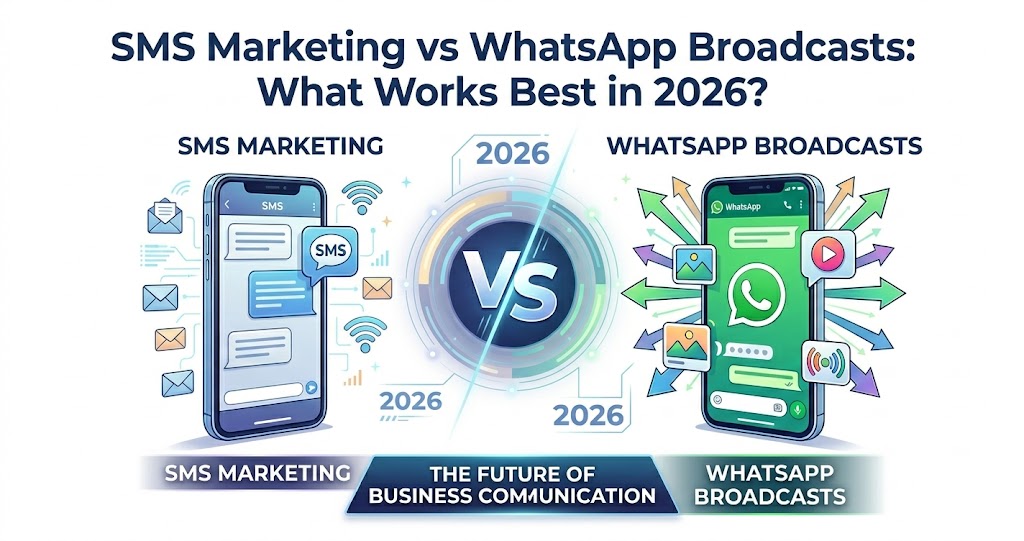
SMS Marketing vs WhatsApp Broadcasts: What Works Best in 2026?
SMS Marketing Tools vs WhatsApp Broadcasts: When to Use Each for Maximum Impact
In today’s fast-moving digital landscape, businesses can no longer depend on a single communication channel to connect with customers. While WhatsApp has rapidly become a preferred platform for conversational marketing, SMS marketing tools continue to hold their ground as one of the most reliable ways to ensure message delivery and maximize reach.
The real challenge isn’t choosing one over the other—it’s understanding when to use WhatsApp broadcasts and when SMS marketing becomes the better option.
This guide explores the strengths of both channels, the scenarios where they perform best, and how combining them through platforms like thesmsbox can significantly enhance your marketing impact.
Why Your Messages May Not Be Reaching Customers
For many businesses, the issue is not campaign creation—it’s ensuring those campaigns actually reach and influence the right audience. Several common challenges can affect messaging performance:
Geographical Restrictions
WhatsApp marketing may be limited or restricted in certain regions. A perfectly crafted campaign can fail simply because templates are not allowed in that country, leaving your audience uninformed.
Timing Issues
Time-sensitive promotions often lose effectiveness if customers are offline. By the time they see your message, the opportunity may already be gone.
Sales Pipeline Delays
Delayed follow-ups or undelivered messages can slow down deal closures. Even strong leads may drop off due to poor communication timing.
Operational Inefficiency
Managing SMS and WhatsApp campaigns separately leads to inefficiencies—switching tools, exporting data, and tracking performance across platforms.
Compliance Challenges
Messaging rules vary across regions. Ignoring them can result in blocked campaigns or account penalties.
Compliance and Regulations You Must Consider
WhatsApp Policies
Marketing messages require prior approval
Messaging limits depend on quality scores
Opt-ins are mandatory
Strict regional rules (e.g., limited promotions in the US)
SMS Regulations
Pre-approved templates (e.g., in India)
Mandatory consent and opt-out options
Higher costs for international messaging
Staying compliant not only ensures delivery but also builds customer trust.
What Makes WhatsApp Broadcasts Effective?
WhatsApp broadcasts are powerful because they combine scale with personalization. Messages are delivered as individual conversations, creating a more personal experience.
High Open Rates
WhatsApp messages are often read within minutes, making them ideal for updates, reminders, and announcements.
Rich Media Support
Businesses can share images, videos, PDFs, catalogs, and interactive buttons—something SMS cannot offer.
Two-Way Communication
Customers can instantly respond, enabling real-time conversations with sales or support teams.
Limitations of WhatsApp
Requires template approvals
Strict content policies
Risk of rejection or reduced messaging limits
Because of these restrictions, WhatsApp works best for engagement and relationship-building, not guaranteed delivery.
Does SMS Marketing Still Work in 2025?
Absolutely. SMS remains one of the most dependable communication channels.
Unlike WhatsApp, SMS:
Works without internet
Is available globally
Has minimal restrictions in delivery
For example, if a WhatsApp campaign is blocked in a region, SMS ensures your message still reaches the customer.
Why SMS Marketing Still Matters
Global Reach
SMS works in virtually every country, regardless of platform restrictions.
No Internet Dependency
Customers only need a mobile network.
High Visibility
SMS inboxes are less crowded, increasing the chances of your message being read.
Reliable Delivery
Perfect for OTPs, alerts, reminders, and urgent notifications.
Best Use Cases for SMS Marketing
Flash sales and urgent promotions
OTPs and transaction alerts
Payment reminders
Service updates or downtime alerts
Reaching users in restricted regions
Limitations of SMS
Text-only format
Limited personalization
No interactive features
SMS is not ideal for long conversations but works best as a reliable support channel.
When Should You Use SMS vs WhatsApp?
Use WhatsApp for engagement, personalization, and media-rich communication
Use SMS for reliability, urgency, and guaranteed delivery
Use both together for maximum coverage and performance
How thesmsbox Brings SMS and WhatsApp Together
Instead of forcing businesses to choose, thesmsbox enables a unified communication strategy by combining both channels into one platform.
This eliminates the need for multiple tools and ensures every message reaches its intended audience.
Key Features of thesmsbox
1. Automated SMS Fallback
If a WhatsApp message fails due to restrictions or delivery issues, thesmsbox automatically sends the same message via SMS.
This ensures:
No missed communication
Better delivery rates
Improved campaign ROI
2. Unified Campaign Management
Run WhatsApp and SMS campaigns from a single dashboard:
Create campaigns faster
Track performance in one place
Avoid data fragmentation
3. Direct SMS Campaigns
Launch SMS campaigns instantly for:
Urgent alerts
Promotions
Compliance messages
Benefits of a Multi-Channel Strategy
Stronger Brand Visibility
Combining WhatsApp and SMS ensures complete audience coverage.
Higher ROI
Missed WhatsApp deliveries are recovered through SMS fallback, improving overall campaign performance.
Better Customer Experience
Customers receive timely and relevant messages, regardless of platform limitations.
Operational Efficiency
A unified platform like thesmsbox reduces manual work and speeds up execution.
Measuring Campaign Success
To evaluate performance effectively, track:
Delivery Rate: Compare WhatsApp vs SMS reach
Read Receipts: Available on WhatsApp
Click-Through Rate (CTR)
Response Rate: Higher on WhatsApp due to two-way messaging
Industry Use Cases
SaaS & Tech
WhatsApp for feature updates
SMS for renewal reminders
E-commerce
WhatsApp for product promotions
SMS for flash sale alerts
Financial Services
WhatsApp for engagement
SMS for OTPs and critical alerts
Quick Campaign Checklist
Before launching a campaign, ask:
Is engagement or delivery more important?
Is your audience in restricted regions?
Is the message time-sensitive?
Do you need rich media or just text?
If engagement matters → use WhatsApp
If reliability matters → use SMS
If both matter → use thesmsbox
Final Takeaway
The most effective marketing strategies don’t rely on a single channel. Instead, they focus on using the right channel at the right time.
WhatsApp broadcasts excel at building relationships and engagement. SMS marketing ensures reliability and reach. Together, they create a powerful communication strategy that maximizes results.
With thesmsbox, businesses no longer need to choose between WhatsApp and SMS. They can leverage both seamlessly from a single platform, ensuring every message is delivered, every opportunity is captured, and every campaign achieves its full potential.
FAQs
Is SMS marketing still effective?
Yes, SMS remains highly effective due to its reliability, global reach, and high open rates.
What is the main difference between SMS and WhatsApp?
WhatsApp offers rich, interactive communication, while SMS focuses on delivery and reach.
When should I use WhatsApp?
For engagement, personalization, and interactive campaigns.
When should I use SMS?
For urgent alerts, OTPs, and guaranteed delivery.
Can I use both together?
Yes, platforms like thesmsbox allow seamless integration of both channels.