SMS Marketing
March 28, 2026
TheSMSBox Team
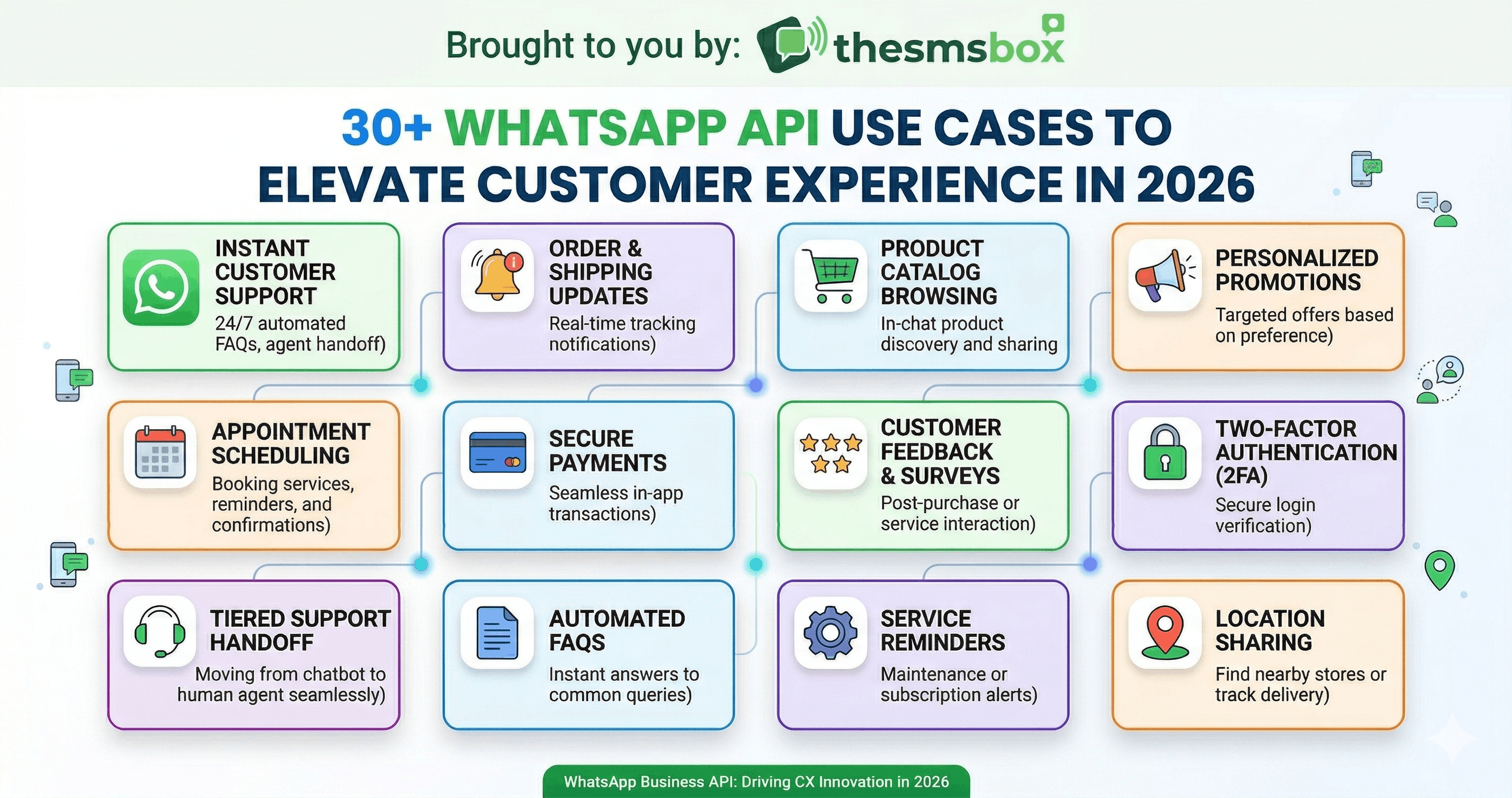
30+ WhatsApp API Use Cases to Elevate Customer Experience in 2026
In 2026, customer expectations are evolving faster than ever. Consumers demand instant responses, personalized interactions, and seamless communication across channels. Businesses that fail to meet these expectations risk losing customers to competitors who offer faster, more convenient experiences. This is where the WhatsApp Business API emerges as a powerful solution.
With over 2 billion active users globally, WhatsApp has become one of the most trusted and widely used messaging platforms. The WhatsApp API enables businesses to automate, personalize, and scale customer communication like never before. From customer support to marketing, sales, and operations, the possibilities are vast.
In this guide, we explore 30+ powerful WhatsApp API use cases that can help businesses elevate customer experience in 2026.
1. Instant Customer Support
Businesses can provide real-time customer support through automated chatbots and live agents. Customers no longer need to wait in long queues or emails—help is just a message away.
2. Automated FAQs
Using chatbots, businesses can answer frequently asked questions instantly, reducing workload on support teams and improving response time.
3. Order Confirmation Notifications
Send automated order confirmations immediately after purchase, including order details, delivery address, and estimated timelines.
4. Delivery Tracking Updates
Keep customers informed with real-time tracking updates, improving transparency and reducing support inquiries.
5. Appointment Booking & Reminders
Healthcare, salons, and service-based businesses can automate appointment scheduling and send reminders to reduce no-shows.
6. Personalized Product Recommendations
Leverage customer data to suggest relevant products based on past purchases and browsing behavior.
7. Abandoned Cart Recovery
Send reminders to customers who left items in their cart, encouraging them to complete their purchase.
8. Lead Qualification
Automate lead qualification by asking questions and filtering potential customers before passing them to sales teams.
9. Click-to-WhatsApp Ads
Run ads that directly open a WhatsApp chat, enabling instant engagement with interested prospects.
10. Customer Feedback Collection
Collect feedback and reviews through automated surveys after a purchase or service interaction.
11. Multi-Agent Customer Support
Enable multiple agents to handle conversations simultaneously, ensuring faster response times and better service.
12. Secure OTP Authentication
Send one-time passwords (OTP) for secure login, registration, and transaction verification.
13. Payment Reminders
Automatically remind customers about pending payments, subscriptions, or invoices.
14. Invoice Sharing
Send invoices directly via WhatsApp for quick and convenient access.
15. Event Notifications
Notify customers about upcoming events, webinars, or product launches.
16. Loyalty Program Updates
Inform customers about loyalty points, rewards, and exclusive offers.
17. Subscription Renewals
Send reminders for subscription renewals to reduce churn.
18. Customer Onboarding
Guide new users through onboarding with step-by-step instructions and helpful tips.
19. Product Catalog Sharing
Showcase products directly within WhatsApp using catalogs for easy browsing.
20. Interactive Message Buttons
Use quick reply buttons to simplify user interaction and improve engagement.
21. Complaint Management
Streamline complaint handling with automated ticket creation and status updates.
22. Service Updates & Alerts
Notify customers about service outages, maintenance, or important updates.
23. Cross-Selling & Upselling
Recommend complementary or premium products to increase average order value.
24. Booking Confirmations
Send confirmations for hotel bookings, travel reservations, and appointments.
25. E-commerce Customer Journey Automation
Automate the entire customer journey from discovery to post-purchase support.
26. Employee Communication
Use WhatsApp API internally for team updates, announcements, and coordination.
27. Surveys & Polls
Conduct interactive surveys to gather insights and improve services.
28. Document Sharing
Send documents like tickets, receipts, contracts, and reports instantly.
29. Crisis Communication
Provide real-time updates during emergencies or disruptions.
30. AI-Powered Chatbots
Integrate AI to provide intelligent, human-like responses and handle complex queries.
31. Multilingual Support
Communicate with customers in their preferred language, improving accessibility and satisfaction.
32. Personalized Campaigns
Run targeted campaigns based on customer segmentation and behavior.
33. Re-engagement Campaigns
Reconnect with inactive customers using personalized messages and offers.
Why WhatsApp API is Essential in 2026
The WhatsApp API is no longer just a communication tool—it’s a complete customer engagement platform. Here’s why businesses are increasingly adopting it:
1. High Open Rates
WhatsApp messages have significantly higher open rates compared to email and SMS, ensuring your message gets noticed.
2. Real-Time Communication
Customers expect instant responses, and WhatsApp enables real-time interaction.
3. Personalization at Scale
With automation and CRM integration, businesses can deliver personalized experiences to thousands of customers simultaneously.
4. Cost Efficiency
Automating repetitive tasks reduces operational costs and improves efficiency.
5. Global Reach
Connect with customers worldwide using a platform they already trust and use daily.
Industries Benefiting from WhatsApp API
Almost every industry can leverage WhatsApp API to improve customer experience:
E-commerce: Order updates, promotions, and support
Healthcare: Appointment reminders and patient communication
Banking & Finance: OTPs, alerts, and customer support
Travel & Hospitality: Booking confirmations and itinerary updates
Education: Notifications, course updates, and student engagement
Real Estate: Lead generation and property inquiries
Best Practices for Using WhatsApp API
To maximize the effectiveness of WhatsApp API, businesses should follow these best practices:
Get User Consent: Always ensure customers opt-in before messaging
Avoid Spam: Send only relevant and valuable messages
Use Automation Smartly: Balance between automation and human interaction
Personalize Messages: Address customers by name and tailor content
Monitor Performance: Track engagement metrics and optimize campaigns
The Future of WhatsApp API
Looking ahead, WhatsApp API will continue to evolve with advancements in AI, automation, and integration capabilities. Features like voice bots, advanced analytics, and deeper CRM integrations will further enhance customer engagement.
Businesses that adopt WhatsApp API early and strategically will gain a competitive advantage by delivering faster, smarter, and more personalized customer experienc